Arsenal have, over the years, had some fantastic partnerships: Smith and Marwood, Adams and Bould, Bergkamp and Ljungberg, Pires and Henry, even Campbell and Toure.
Now, in the spring of 2009 / 2010, another might - just might - be emerging. As 2002 is remembered for Bergkamp - Ljungberg, could 2010 be remembered for Bendtner - Eboue?
At first, of course, it seems unlikely. Eboue is a right-back who can’t defend. Bendtner, meanwhile, has the touch of a blacksmith.
In August, neither was near the first team. If Arsene Wenger has an archetypal player, it isn’t Eboue, and it certainly isn’t Bendtner, the northern European number nine.
Yet their difference is their strength: both, in business terms, have Unique Selling Points. That, in Arsenal’s identikit squad, makes them valuable. They give variety to Arsenal’s one-dimensional attack.
A team of Arshavins, and Nasris, and Rosickys, is, on its day, fantastic. Ten-yard passes slip through ten-inch gaps; the team moves like five-thousand swifts in formation.
Problem is, that day doesn’t often happen. When teams defend deep, and narrow, and well, Arsenal suffocate. They need room, and without it, they’re dead. Chelsea and Manchester United have worked that out. Perhaps Stoke will, as well.
That’s why Arsenal need players that aren’t like Arshavin, Nasri, and Rosicky. They need players who want to win games, not Goal of the Month.
Eboue, unlike Arsenal’s midfielders, doesn’t want the ball every five seconds. He’s happy enough - and quick enough - to ignore the ball, run past opponents, and stretch them. Defenders are happy when everything’s in front of them. When they’re made to turn, they panic.
Bendtner, unlike Arsenal’s other attackers, doesn’t want the ball forty yards from goal. His touch isn’t good enough. He’d be happy to touch the ball three times a game, if it meant three goals.
Also - for the first time since John Hartson - he’s an Arsenal striker who attacks the ball at height. Wenger, since Francis Jeffers, has ditched the Fox in the Box tag. But that's what Bendtner is.
So Bendtner and Eboue are different. But that, alone, doesn’t make them a partnership. What makes them exciting - and why Wenger has dropped Bacary Sagna - is this: their strengths compliment each other. Bendtner and Eboue, Arsenal’s two odd-shaped pieces, fit together nicely.
Eboue likes to hit the byline, and cross. He likes to skim balls across the six-yard box, or smack balls to the far post. And that’s where Bedntner likes to play. He’s far happier at the back post, waiting for an Eboue cross, than on a defender’s shoulder, waiting for a Nasri one-two.
Arshavin, Nasri, and Rosicky score goals one way. Bendtner and Eboue score them another. Between them, they could score winners in ten of the next 11 games. And that - with Chelsea on the front pages, and Manchester United on the back foot - might be enough.
Showing posts with label Nicklas Bendtner. Show all posts
Showing posts with label Nicklas Bendtner. Show all posts
Tuesday, 23 February 2010

Thursday, 11 February 2010
Now, the most important player wears 52
With 12 games left in this barnstorming, bewildering season, who is Arsenal’s most important player? Clues: he has no pace, a bouncy touch, and wears 52 on his back.
Nicklas Bendtner, of course, isn’t Arsenal’s best player. In fact, he’s probably sixth, seventh, or eighth best. But without him, there’s a huge, unfillable hole where a centre-forward should be.
Remove any Arsenal player, bar Bendtner, and there’s a replacement. Sol Campbell, for example, could step in for Thomas Vermaelen or William Gallas. Lukasz Fabianksi couldn’t do worse than Manuel Almunia.
The full-backs have deputies, as do the stream of identikit, five-foot nothing midfielders, like Samir Nasri, Tomas Rosicky, and Fran Merida. Even Cesc Fabregas, as special as he is, has a Welsh protégé in the wings.
But without Bendtner, Arsene Wenger has two options: a half-paced Croatian with stale limbs, or a Russian midfielder who centre-halves look down on. In short, without Bendtner, Wenger has no options.
Of course, the Dane won’t be first pick in the London Colney five-a-sides. He hasn’t the touch. As Gooners remind him, he doesn’t look like an Arsenal player. But, in 4-5-1, does that matter? In that system, it’s the midfield five who play football.
They’re the ones who pass, move, and make chances. The striker should watch and admire from the 18-yard box, then finish the chances the midfield serve. The fewer touches the centre-forward has, the better the team are playing.
(When Robin van Persie first played up front alone, he chased the ball, playing one-twos on the right wing. He didn’t score in August. When he started goal-hanging, he started scoring.)
But, with van Persie injured, Bendtner is the only centre-forward left. His importance, therefore, is partly Hobson’s Choice: he’ll have to do, because there’s no-one else. Yet there’s another reason he’s vital. He, unlike any other Arsenal forward, can head the ball.
Last night’s game against Liverpool showed how important that is. Again, Arsenal’s one-touch, through-the-middle passing wasn’t working. So, for the first time in eight games, they played a good cross, from a good position, to a good header. It’s called variety, and it’s something Arsenal haven’t had.
In fact, it was Arsenal’s first headed league goal since December 30th, when Portsmouth were on the floor, and, with five minutes left, Alex Song rose above them. Of Arsenal’s 61 league goals this season, only six have come from headers. That’s fewer than Chelsea (ten), West Ham (ten), Aston Villa (9), Manchester United (8), Tottenham (8), and Everton (7).
Arsenal, remarkably, can still win the league. The next seven games prove that: Sunderland, Stoke, Burnley, Hull, West Ham, Birmingham, and Wolves. But they won’t take 19 points if they only score Goals of the Month.
The six-foot-five number 52 offers the much-sought-after Plan B. He should leave the passing to the passers, and use his head. With Marouane Chamakh likely to arrive this summer, he has 12 games to make his career. If he succeeds, he could celebrate with a league winner's medal.
Nicklas Bendtner, of course, isn’t Arsenal’s best player. In fact, he’s probably sixth, seventh, or eighth best. But without him, there’s a huge, unfillable hole where a centre-forward should be.
Remove any Arsenal player, bar Bendtner, and there’s a replacement. Sol Campbell, for example, could step in for Thomas Vermaelen or William Gallas. Lukasz Fabianksi couldn’t do worse than Manuel Almunia.
The full-backs have deputies, as do the stream of identikit, five-foot nothing midfielders, like Samir Nasri, Tomas Rosicky, and Fran Merida. Even Cesc Fabregas, as special as he is, has a Welsh protégé in the wings.
But without Bendtner, Arsene Wenger has two options: a half-paced Croatian with stale limbs, or a Russian midfielder who centre-halves look down on. In short, without Bendtner, Wenger has no options.
Of course, the Dane won’t be first pick in the London Colney five-a-sides. He hasn’t the touch. As Gooners remind him, he doesn’t look like an Arsenal player. But, in 4-5-1, does that matter? In that system, it’s the midfield five who play football.
They’re the ones who pass, move, and make chances. The striker should watch and admire from the 18-yard box, then finish the chances the midfield serve. The fewer touches the centre-forward has, the better the team are playing.
(When Robin van Persie first played up front alone, he chased the ball, playing one-twos on the right wing. He didn’t score in August. When he started goal-hanging, he started scoring.)
But, with van Persie injured, Bendtner is the only centre-forward left. His importance, therefore, is partly Hobson’s Choice: he’ll have to do, because there’s no-one else. Yet there’s another reason he’s vital. He, unlike any other Arsenal forward, can head the ball.
Last night’s game against Liverpool showed how important that is. Again, Arsenal’s one-touch, through-the-middle passing wasn’t working. So, for the first time in eight games, they played a good cross, from a good position, to a good header. It’s called variety, and it’s something Arsenal haven’t had.
In fact, it was Arsenal’s first headed league goal since December 30th, when Portsmouth were on the floor, and, with five minutes left, Alex Song rose above them. Of Arsenal’s 61 league goals this season, only six have come from headers. That’s fewer than Chelsea (ten), West Ham (ten), Aston Villa (9), Manchester United (8), Tottenham (8), and Everton (7).
Arsenal, remarkably, can still win the league. The next seven games prove that: Sunderland, Stoke, Burnley, Hull, West Ham, Birmingham, and Wolves. But they won’t take 19 points if they only score Goals of the Month.
The six-foot-five number 52 offers the much-sought-after Plan B. He should leave the passing to the passers, and use his head. With Marouane Chamakh likely to arrive this summer, he has 12 games to make his career. If he succeeds, he could celebrate with a league winner's medal.
Friday, 15 January 2010
Bendtner will be Arsenal's new striker
With 16 days of the transfer window left, Arsene Wenger still hasn’t signed a striker. Carlton Cole, who’s injured, is staying at West Ham. Marouane Chamakh, the French-born Moroccan, is seeing out his Bordeaux contract.
Arsenal will play the Bolton double-header with Eduardo up-front: the half-fit, half-frozen Eduardo, the lost Brazilian who can’t find his old self.
But, for once, Wenger’s money-under-the-mattress transfer policy is right. Why buy Cole, or Chamakh, when the best tall, young striker in Europe is at your club, and two weeks from fitness?
Nicklas Bendtner is 21 (22 tomorrow). At that age, Emmanuel Adebayor was throwing diamond watches out of his pram at Monaco, after scoring 20 goals in 100 games. Didier Drogba was at Le Mans, going a whole season (2000 / 2001) without scoring. Les Ferdinand, who had the best leap in English football, was playing for Hayes.
The point is, big strikers don’t arrive in top-level football like small strikers. When Wayne Rooney was 16, he danced round Arsenal and scored a 30-yard wonder goal. Michael Owen peaked - peaked - when he was 18, sprinting past Argentina at the World Cup.
Small strikers’ strengths - speed, movement, and agility - need young, unworn muscles. Big strikers’ strengths - leaping, muscle, and cunning - take age, and experience. Bendtner, a 21-year-old big man, is five years from his zenith.
Despite that, he hasn’t done badly. In 52 Arsenal starts, he’s scored 27 goals. Many of those appearances - and his 54 from the bench - have seen him stuck on the wing, out of place, like the tall kid in the school photo.
For Denmark, he’s scored ten goals in 30 games, and is their player of the year. Watch his goal at home to Portugal on You Tube: strength, touch, and perfect left-foot finish. He didn’t learn that from Adebayor. The African would have fallen at the first challenge, pleading for a penalty.
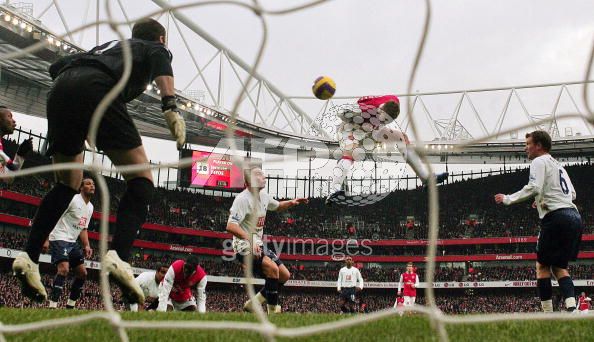
For more proof of Bendtner’s potential, how about this picture, taken while scoring the winner against Spurs? His feet are almost two yards from the floor! Even Les Ferdinand didn’t do that.
Bendtner frustrates Arsenal fans because he’s not a winger. When Wenger plays him there, his average touch, and average pace, are shown up. But if he played ten games up front, he’d score five goals, with at least two headers. And wouldn’t that add something to Arsenal’s one-dimensional, perfect-or-nothing attacks?
In 16 days, and without him kicking a ball, we’ll know where Bendtner’s Arsenal career is going. Let’s hope it’s onwards, and upwards.
Arsenal will play the Bolton double-header with Eduardo up-front: the half-fit, half-frozen Eduardo, the lost Brazilian who can’t find his old self.
But, for once, Wenger’s money-under-the-mattress transfer policy is right. Why buy Cole, or Chamakh, when the best tall, young striker in Europe is at your club, and two weeks from fitness?
Nicklas Bendtner is 21 (22 tomorrow). At that age, Emmanuel Adebayor was throwing diamond watches out of his pram at Monaco, after scoring 20 goals in 100 games. Didier Drogba was at Le Mans, going a whole season (2000 / 2001) without scoring. Les Ferdinand, who had the best leap in English football, was playing for Hayes.
The point is, big strikers don’t arrive in top-level football like small strikers. When Wayne Rooney was 16, he danced round Arsenal and scored a 30-yard wonder goal. Michael Owen peaked - peaked - when he was 18, sprinting past Argentina at the World Cup.
Small strikers’ strengths - speed, movement, and agility - need young, unworn muscles. Big strikers’ strengths - leaping, muscle, and cunning - take age, and experience. Bendtner, a 21-year-old big man, is five years from his zenith.
Despite that, he hasn’t done badly. In 52 Arsenal starts, he’s scored 27 goals. Many of those appearances - and his 54 from the bench - have seen him stuck on the wing, out of place, like the tall kid in the school photo.
For Denmark, he’s scored ten goals in 30 games, and is their player of the year. Watch his goal at home to Portugal on You Tube: strength, touch, and perfect left-foot finish. He didn’t learn that from Adebayor. The African would have fallen at the first challenge, pleading for a penalty.
For more proof of Bendtner’s potential, how about this picture, taken while scoring the winner against Spurs? His feet are almost two yards from the floor! Even Les Ferdinand didn’t do that.
Bendtner frustrates Arsenal fans because he’s not a winger. When Wenger plays him there, his average touch, and average pace, are shown up. But if he played ten games up front, he’d score five goals, with at least two headers. And wouldn’t that add something to Arsenal’s one-dimensional, perfect-or-nothing attacks?
In 16 days, and without him kicking a ball, we’ll know where Bendtner’s Arsenal career is going. Let’s hope it’s onwards, and upwards.
Subscribe to:
Posts (Atom)